
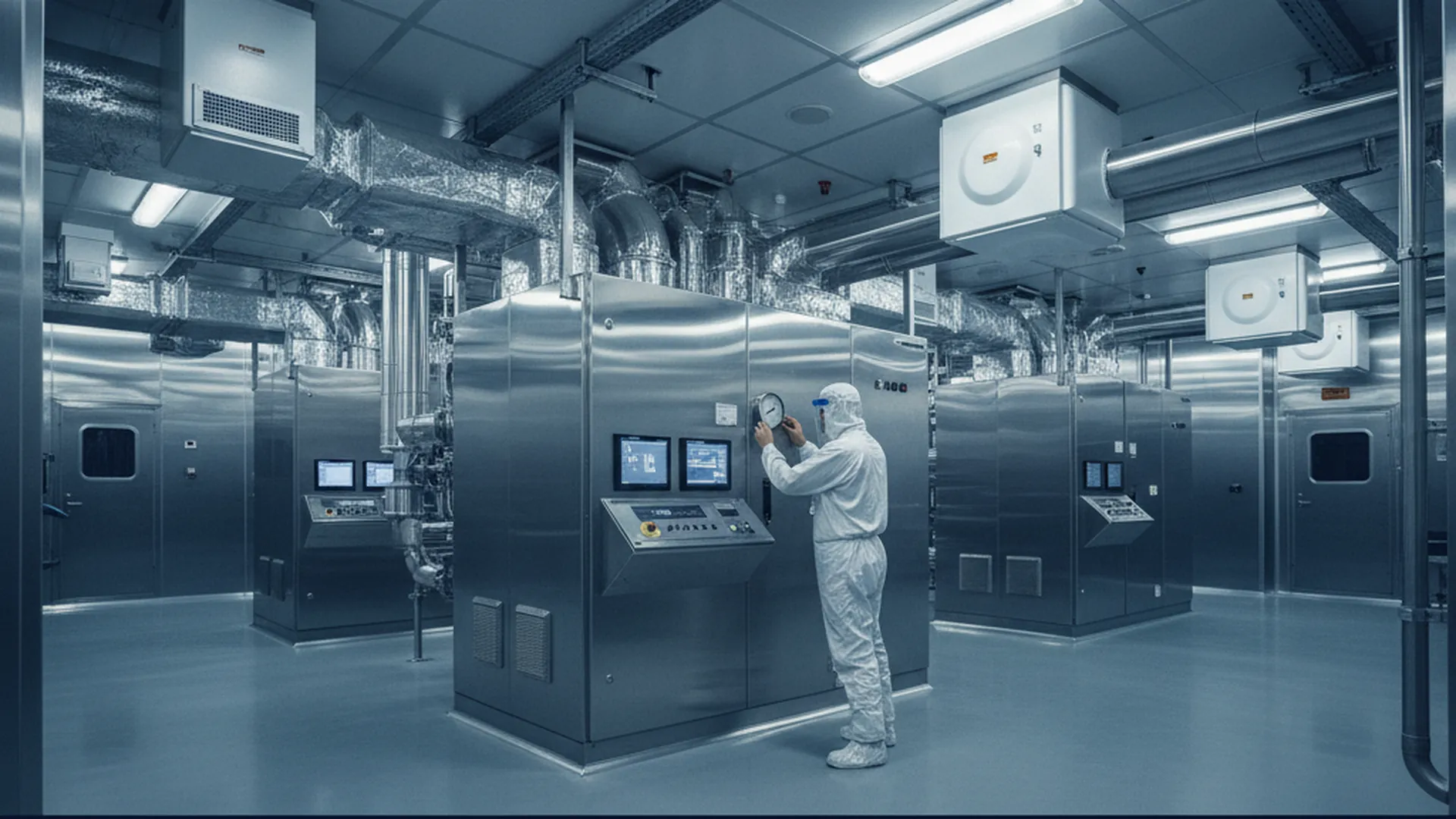

EU GMP Annex 1, the Manufacture of Sterile Medicinal Products guidance, is a contamination-control framework. It is not an HVAC standard. But its implications for the mechanical plant are concrete enough that any designer working sterile pharma scope has to engineer around them.
The grading system: A, B, C, D
Annex 1 defines four cleanliness grades, in descending order of contamination control. Grade A is the critical zone (typically inside an isolator or under a unidirectional airflow hood). Grade B is the background environment for Grade A. Grades C and D handle support functions.
For HVAC: each grade has at-rest and in-operation particle limits, recovery time requirements after disturbance, and implicit air-change-rate (ACR) targets that the design has to support.
Pressure cascade
Cleanrooms operate above ambient pressure to prevent airborne contamination ingress. Annex 1 doesn't specify exact differentials, but expects a designed cascade, typically 10–15 Pa between adjacent classified zones. The HVAC plant has to hold that cascade through occupancy changes, equipment operation and door events. Recovery has to be fast enough that the cascade is not violated for measurable durations.
Validated control loops
Annex 1 expects continuous monitoring of temperature, humidity, particle counts and pressure differential, with alarms, trend recording and the documentation to support periodic review. The BMS implementation has to support this. Control loops have to be validated against the user requirement specification (URS), and the validation documentation is itself an audit artefact.
Recovery time
After a disturbance, a door opening, equipment cycling, personnel movement, the cleanroom has to recover its particle classification within a defined window. ISO 14644-3 specifies recovery time measurement methods. Annex 1 doesn't specify a maximum recovery time directly, but the contamination-control logic requires that recovery is fast enough to keep the critical operations within their grade.
What this means for design
- Higher air change rates than commercial baseline, often 20–60 ACH for grade B/C
- HEPA filtration at supply, sometimes return
- Cascading return-air strategy to maintain pressure differentials
- BMS integration that supports continuous monitoring, alarming and trend recording
- Validation documentation that survives audit, including FAT/SAT/IQ/OQ/PQ packages
RS Marine delivers this scope under a single contract, design, implementation, BMS integration, commissioning measurements. The interface gaps that fragment most pharma HVAC projects (where designer, installer and controls integrator operate as separate vendors) collapse into a single delivery chain. Annex 1 documentation is part of the deliverable, not an afterthought.
RS Marine Sp. z o.o. delivers hull construction, refit and repair, industrial HVAC and electrical installations from Gdynia, Poland. Operating since 2018 with IACS-affiliated welders and a team of over 100 specialists.