
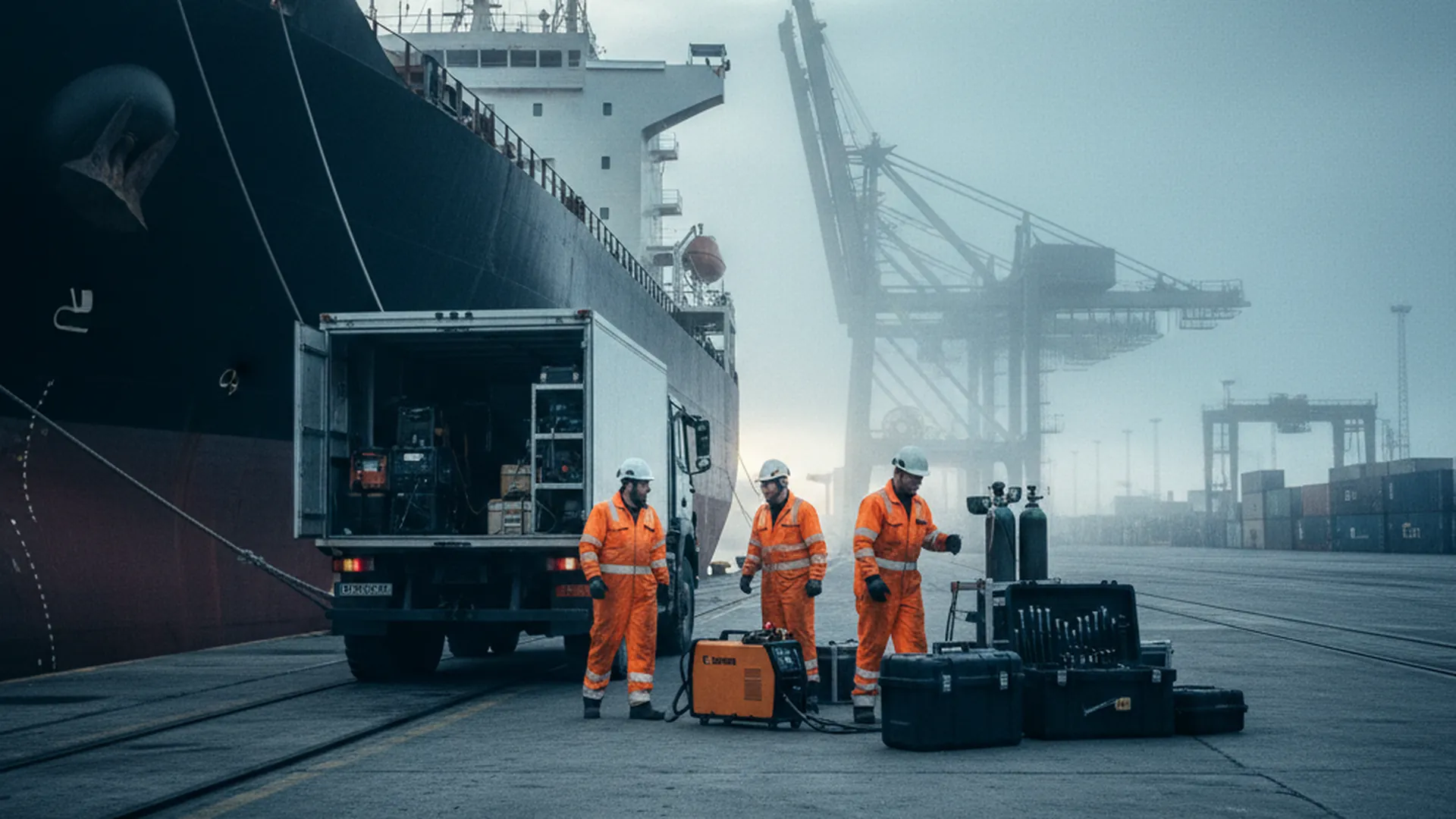

A bulk carrier hits the wall at a German port. Class wants structural repair before sailing. The vessel has a forty-eight-hour stay window before the next charter slot. The repair scope itself is straightforward, two days of work for a four-person crew. What decides whether the work happens inside the window is not welding skill. It is the logistics chain behind it.
The window is the constraint
A scheduled yard stay gives weeks of planning runway. Mobile-repair work in a commercial port runs against the operator's sailing schedule. The window is what the port agent has secured, sometimes from negotiating with the next vessel's pilot. Crew and equipment have to arrive, work, hand over, demobilise inside that window or the vessel pays demurrage.
Pre-arrival documentation
- Crew passports and EU work documents (or schengen visa) verified before booking transit
- Welder certifications and continuity records ready as digital and printed copies
- WPS for the expected scope pre-approved with the attending surveyor
- Port-access pass arranged through the local agent for each crew member
- Equipment manifest with weights, dimensions, hazardous-material classifications for customs clearance
Equipment, by sea or by road
A four-person crew with welding equipment, gas bottles, grinding tools and NDT gear is a two-tonne consignment. From Gdynia to a German or Swedish port that is overnight by ferry or eight to twelve hours by road. The choice depends on the window. Ferry costs less and runs reliably; road is faster and gives the crew arrival flexibility. We have templates for both.
Coordination on the ground
On arrival, the port agent meets the crew, hands over passes and points them to the berth. The vessel's chief officer takes the crew through the scope and the ship-side safety brief. The class surveyor, if attending, joins. From there the crew is on the work. A good port agent and a clear pre-arrival brief shorten the on-board setup from a half-day to two hours. That is real productive welding time recovered.
When the scope changes mid-job
A vessel survey often reveals more than the initial scope. A second adjacent plate also needs renewal. A bracket weld has cracked. The crew has to assess, communicate to the office, get a quote-extension approved by the operator and continue, all without losing the window. Mobile-repair work demands judgement on the deck, not just instructions from a desk.
How RS Marine handles it
Our mobile-repair scope runs from Gdynia across the Baltic to German, Danish, Swedish and Finnish ports. The template is in place: pre-arrival documentation, equipment manifest, crew assignment, port-agent coordination. A typical mobilisation runs forty-eight to seventy-two hours from confirmation to crew on board. The work itself starts on hour one of the stay window, not on hour eight after setup is done.
RS Marine Sp. z o.o. delivers hull construction, refit and repair, industrial HVAC and electrical installations from Gdynia, Poland. Operating since 2018 with IACS-affiliated welders and a team of over 100 specialists.