
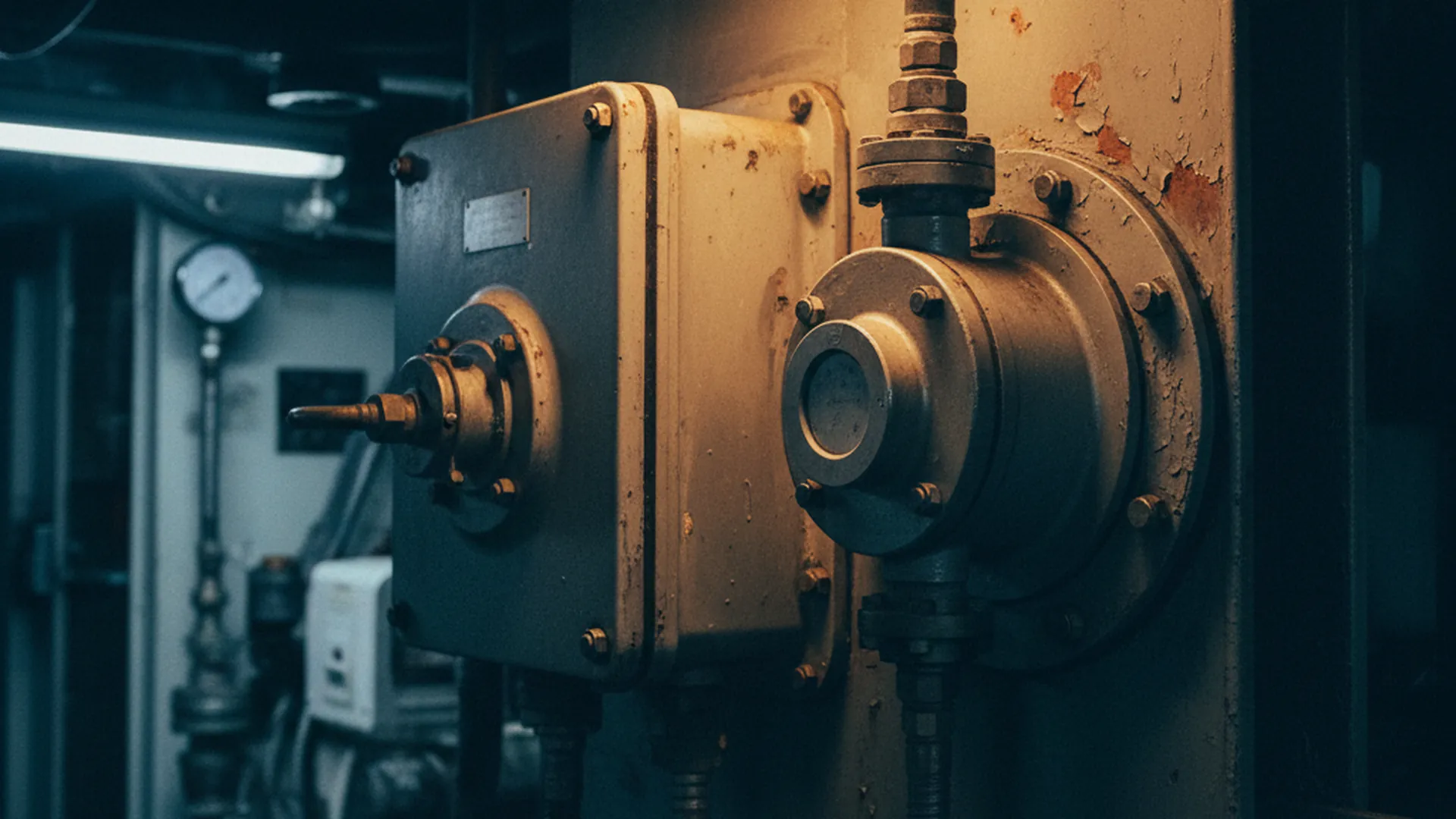

Cargo pump rooms on tankers, bunker stations on LNG-fuelled vessels, paint stores, battery compartments on hybrid ships: each is an environment where an electrical spark in the wrong place can ignite a flammable atmosphere. Two regulatory frameworks govern equipment selection in these spaces, ATEX in the EU and IECEx as the international scheme. They overlap in substance but differ in marking, in the documentation chain and in how the classification surveyor expects them on board.
Zones, not just rooms
Ex protection starts with classifying the space, not the equipment. Zone 0 is where an explosive atmosphere is present continuously or for long periods (typical: inside a cargo tank). Zone 1 is where it can occur during normal operation (cargo pump rooms, tank vent risers within a defined radius). Zone 2 is where it is not expected during normal operation but may occur briefly (the outer envelope around Zone 1 sources). Each zone dictates the equipment category that can be installed there.
ATEX vs IECEx
ATEX is the EU directive set (2014/34/EU for equipment, 1999/92/EC for workplaces). Equipment intended for the EU market is CE-marked with the Ex symbol and the category. IECEx is the international IEC scheme, technically aligned with the IEC 60079 series. Most marine equipment carries both, with both certificates in the file. For a vessel built for European ownership but trading internationally, having both available short-cuts surveyor questions in non-EU ports.
Equipment categories
Category 1 equipment is approved for Zone 0 (highest protection level, intrinsic safety or equivalent). Category 2 is for Zone 1 (flameproof enclosures, increased safety, pressurisation). Category 3 is for Zone 2 (non-sparking under normal operation). A common documentation mistake is installing Category 2 equipment in Zone 0, or pulling a Category 3 luminaire into Zone 1 because the conduit run was easier. Surveyors catch this.
What surveyors actually check
- Certificate of conformity matching the installed equipment serial number
- Cable gland type matching the equipment certification (Ex d, Ex e or Ex i)
- Cable transit certification preserved through bulkhead penetrations
- Installation in line with the manufacturer's installation drawing
- Continuity of the bonding and earthing scheme through to the hull
Documentation chain
For each Ex item on board: the type certificate (ATEX or IECEx or both), the installation drawing, the cable schedule showing which conductor lands on which terminal, and the inspection record at handover. Class societies want this assembled before sea trials, not after. The chain is what proves the equipment is not just compliant on paper but installed in line with its certificate envelope.
How RS Marine handles it
Electrical scope in Ex zones is part of our standard delivery. We work to ATEX/IECEx documentation, with cable glands and transits matched to the equipment certificate and installation drawings on file. At handover, the inspection records are part of the dossier for the surveyor, not chased after the fact. This applies whether the scope is a cargo pump room retrofit at NAUTA, an LNG bunkering installation at a partner yard, or a battery compartment in a hybrid ferry programme.
RS Marine Sp. z o.o. delivers hull construction, refit and repair, industrial HVAC and electrical installations from Gdynia, Poland. Operating since 2018 with IACS-affiliated welders and a team of over 100 specialists.