
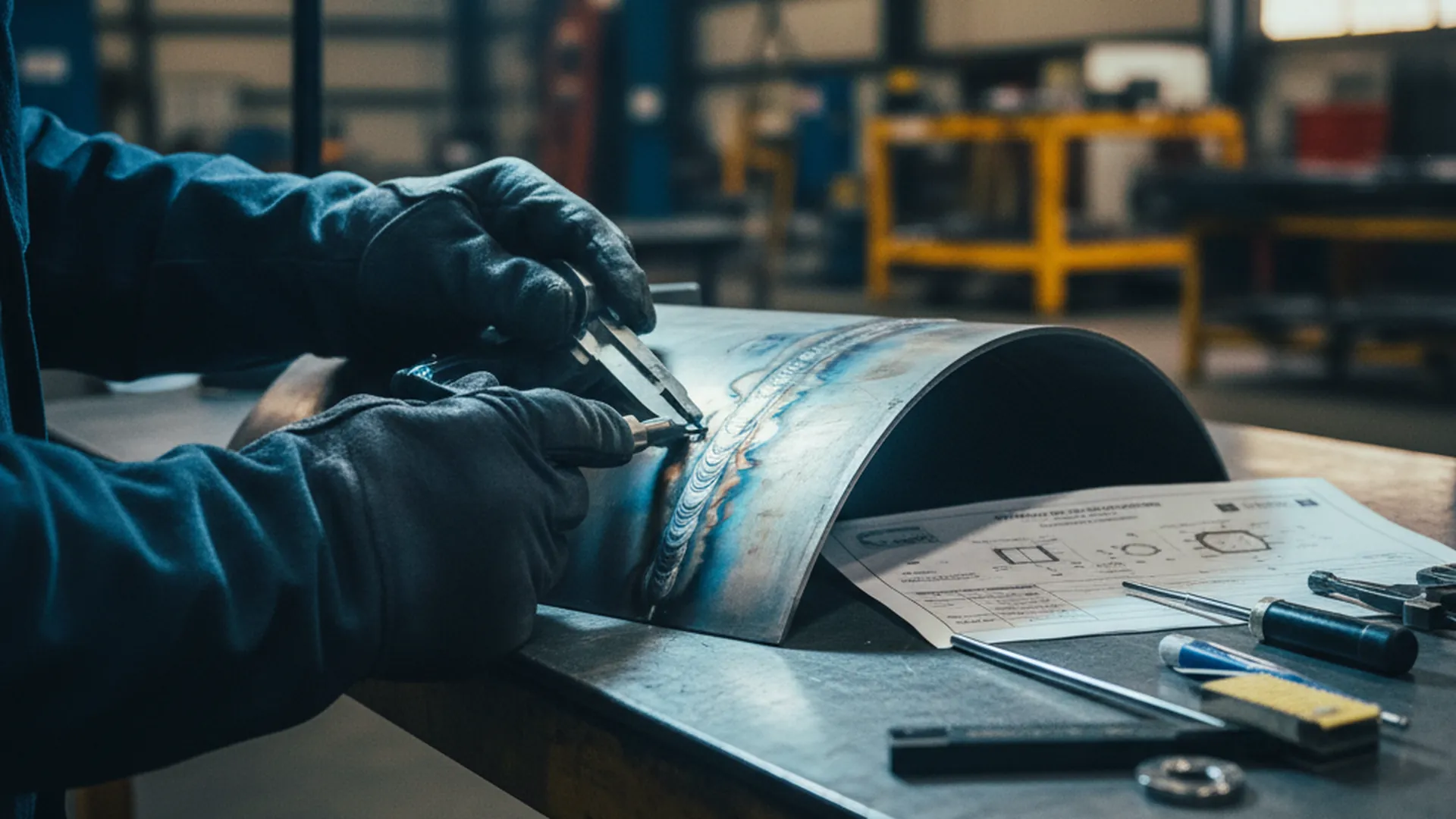

In a hull-construction tender, the surveyor will not start signing welds before the procedure documentation is in the file. WPS, Welding Procedure Specification, says how a joint will be welded. PQR, Procedure Qualification Record, says that the WPS has been tested and proven on a real coupon to deliver mechanical properties that meet the standard. These two documents are bound. A WPS without a PQR is a draft, not an authorisation.
What a WPS specifies
A typical marine WPS specifies the base material grade and thickness range, the filler metal, the welding process (GMAW, FCAW, SAW, SMAW), the joint geometry, the welding position, preheat and interpass temperatures, current and voltage ranges, travel speed and the shielding gas if applicable. Every variable that can affect the weld's mechanical properties is bounded. A welder operates inside that envelope.
What a PQR records
A PQR documents the test weld that proved the WPS works. Tensile, bend, impact (Charpy V-notch) and macro examination results. The test coupon dimensions. The actual recorded values, not the WPS targets. If a destructive test fails, the WPS does not get qualified and the procedure has to be reworked or re-tested.
Which standard governs
In European yards, ISO 15614-1 is the dominant qualification standard for structural steels under most class regimes. ASME IX is used in pressure-equipment scope and on certain ABS-class American programmes. EN ISO 15609 governs the WPS content format. Class societies publish their own deviations and additions on top, but the substance is the international standard plus a class-specific overlay.
Where things typically slip
- WPS issued without a current PQR in the file: caught at the first surveyor audit
- PQR qualification range narrower than the production scope: the welder operates outside the qualified envelope
- Filler-metal batch traceability missing: the PQR was on lot A, production runs on lot B with no equivalence statement
- Welder qualified to a different WPS variant than the one being welded: the welder ticket and the WPS do not match
- Recalibration of welding-equipment voltage/current not documented: actuals drift from the WPS envelope
How the surveyor reviews
The surveyor will sample weld production records, pull the WPS for each, verify that the welder ticket allows that scope, that the PQR is current, that the production parameters logged at the weld are inside the WPS envelope and that NDT (visual, MT or PT, UT, RT) has been performed and signed. A pattern of borderline-compliant records is itself a finding.
How RS Marine handles it
For each programme, we present the WPS/PQR set covering the scope before mobilisation. Welders are assigned to scopes within their qualified envelope, with traceability through the welder roster. Production parameters are logged. NDT is run by certified personnel. The class surveyor sees a complete, internally consistent procedure file on first review. This is how we work at DAMEN on hull blocks, at NAUTA on repair scope and at Karstensen on commercial vessel construction.
RS Marine Sp. z o.o. delivers hull construction, refit and repair, industrial HVAC and electrical installations from Gdynia, Poland. Operating since 2018 with IACS-affiliated welders and a team of over 100 specialists.